Address
Lot 508-1B, Jalan Morib Kg, Kanchong Darat, 42700 Banting, Selangor
Work Hours
Monday to Friday: 10am – 5pm

Address
Lot 508-1B, Jalan Morib Kg, Kanchong Darat, 42700 Banting, Selangor
Work Hours
Monday to Friday: 10am – 5pm

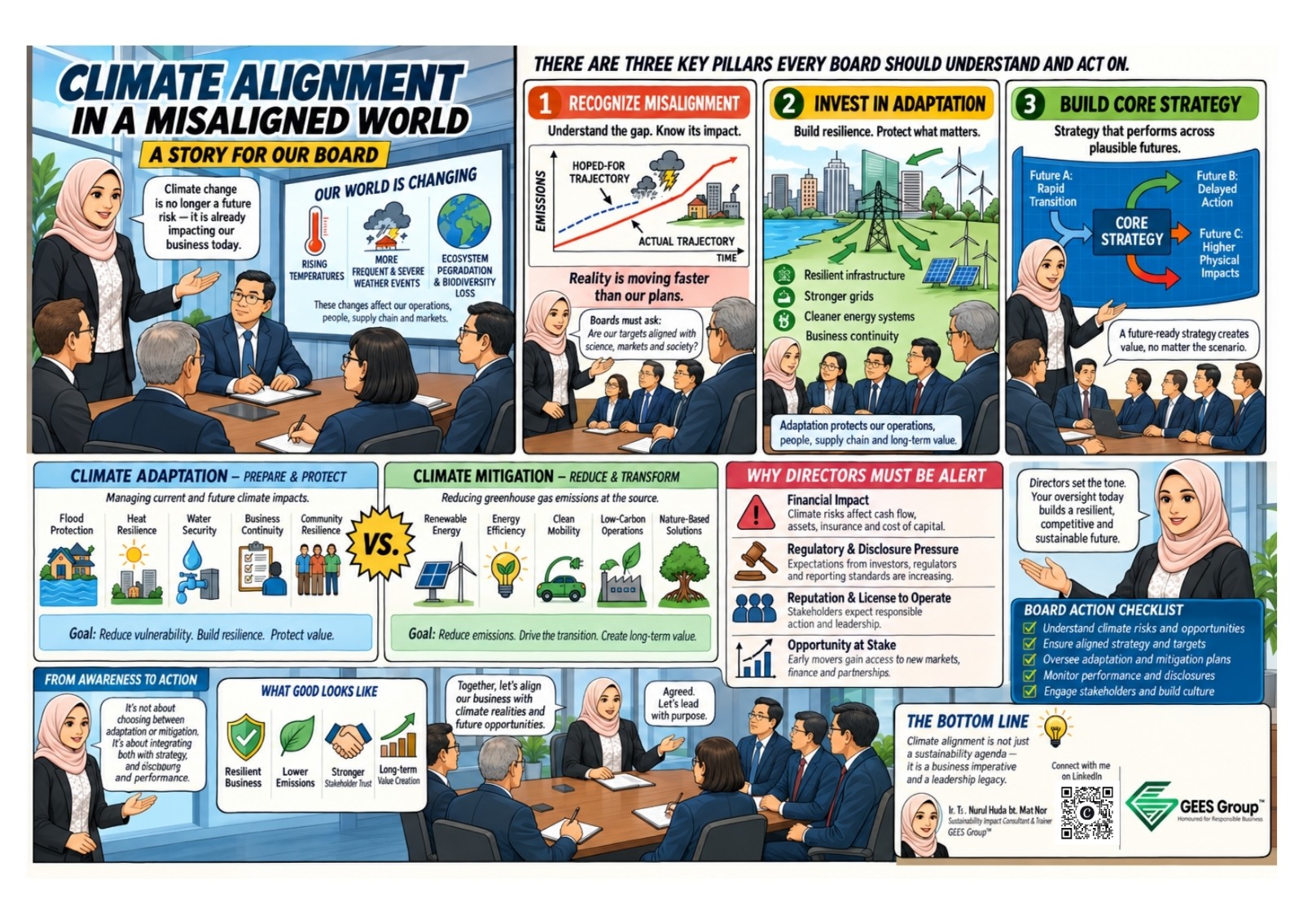
Climate change is no longer a future risk. It is already affecting businesses today through rising temperatures, more frequent and severe weather events, ecosystem degradation, biodiversity loss and increasing disruption across operations, supply chains and markets.
For boards and business leaders, this means climate considerations can no longer sit outside core strategy. The question is no longer whether climate change will affect the business, but how prepared the organisation is to respond.
There are three key areas that boards should focus on when addressing climate-related challenges.
1. Recognise Misalignment
Many organisations continue to operate based on assumptions, targets and plans that may no longer reflect the speed of climate change.
Reality can move faster than strategy.
Boards therefore need to continuously assess whether current business targets, assumptions and strategic priorities remain aligned with science, market developments and stakeholder expectations.
Recognising the gap is the first step towards taking meaningful action.
2. Invest in Adaptation
Climate adaptation is about preparing for and managing both current and future climate impacts.
This may include strengthening flood protection, improving heat resilience, enhancing water security, building business continuity capabilities and strengthening community resilience.
The objective is clear: reduce vulnerability, protect operations and preserve long-term value.
Adaptation is not only about managing risk. It is also about protecting people, supply chains, infrastructure and business continuity.
3. Build a Core Strategy for Multiple Futures
Climate uncertainty means businesses must be prepared for more than one possible future.
Some organisations may face a rapid transition towards a low-carbon economy. Others may experience delayed action, while some may face increasing physical climate impacts.
A resilient strategy must therefore be able to perform across different scenarios.
The strongest organisations will not simply respond to climate change as it happens. They will build strategies that remain relevant under a range of plausible futures.
Although often discussed together, climate adaptation and climate mitigation serve different purposes.
Climate adaptation focuses on preparing for climate impacts and reducing vulnerability. This may involve flood protection, heat resilience, water security and stronger business continuity planning.
Climate mitigation, on the other hand, focuses on reducing greenhouse gas emissions at the source. This includes renewable energy, energy efficiency, clean mobility, low-carbon operations and nature-based solutions.
Both are essential.
Adaptation protects the organisation from climate impacts, while mitigation helps drive the transition towards a lower-carbon future.
For businesses, the strongest approach is not to choose between the two, but to integrate both into overall strategy.
Climate risks can have a direct impact on business performance.
They may affect cash flow, assets, insurance costs and the cost of capital.
At the same time, regulatory and disclosure expectations are increasing. Investors, regulators and stakeholders are placing greater attention on how organisations identify, manage and communicate climate-related risks and opportunities.
There is also a reputational dimension.
Stakeholders increasingly expect businesses to demonstrate responsible action, strong leadership and credible progress.
However, climate action is not only about risk.
There are also opportunities.
Organisations that act early may gain access to new markets, financing opportunities, stronger stakeholder confidence and long-term competitive advantage.
Climate alignment is not simply about choosing between adaptation and mitigation.
It is about integrating climate considerations into:
What does good climate alignment look like?
It means building a more resilient business, lowering emissions, strengthening stakeholder trust and creating long-term value.
For boards, this requires active oversight and clear accountability.
Directors should understand climate-related risks and opportunities, ensure that business strategy remains aligned with changing conditions, oversee adaptation and mitigation plans, monitor performance and disclosures, and strengthen stakeholder engagement across the organisation.
Climate alignment is no longer only a sustainability agenda.
It is a business imperative.
Organisations that integrate climate considerations into decision-making today will be better positioned to build resilience, protect value and remain competitive in an increasingly uncertain world.
For boards and business leaders, the challenge is clear:
Understand the risk. Align the strategy. Build resilience. Act with purpose.
At GEES Group, we believe that responsible business begins when sustainability moves beyond discussion and becomes part of strategy, governance and everyday decision-making.
